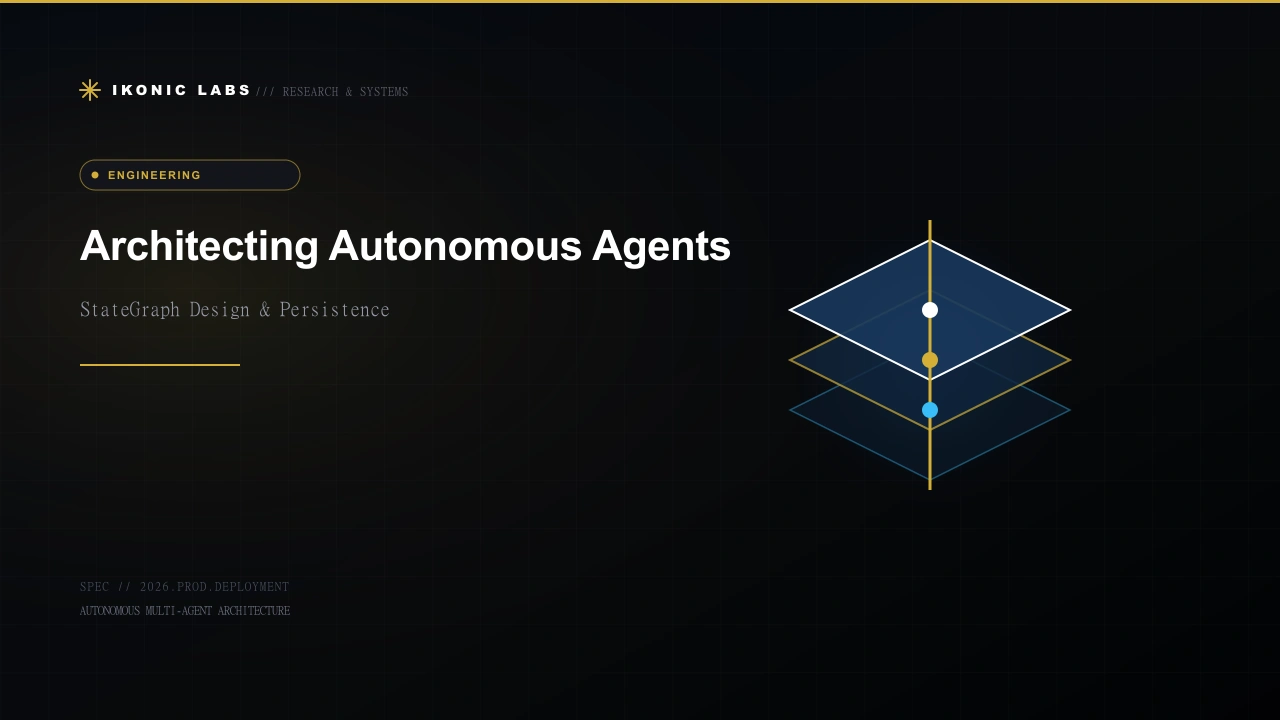
1. The Maturation of Agentic Systems Engineering
The transition from experimental AI prototypes to enterprise-grade autonomous software represents the defining engineering challenge of 2026. Early generative AI implementations relied on stateless, single-turn prompts that executed isolated text transformations. In contrast, true autonomous AI agent systems are stateful, long-running computational graphs capable of perceiving dynamic environments, maintaining multi-turn context, invoking external tools, and executing persistent database transactions.
Engineering these systems requires strict adherence to classical distributed systems principles: idempotent API execution, event-sourced state persistence, deterministic verification guardrails, and distributed transaction recovery.
At IKONIC LABS, our systems engineering practice has built and scaled mission-critical autonomous architectures across fintech, supply chain, and conversational intelligence. This master blueprint provides lead architects and technical founders with the complete systems specification for building production-grade custom AI agents in 2026.
⚡ IKONIC LABS • AI Systems Engineering
Ready to Deploy Custom AI Agents for Your Enterprise?
From 48hr scoping to production SaaS and multi-agent workflows — built by engineers who ship.
2. The 5 Foundational Layers of Production Agent Architecture
1. Sensory Ingestion & Context Framing Layer
Ingests multimodal sensory data (structured JSON payloads, raw text streams, audio PCM deltas, or scanned PDF documents) and cleanses noise. Performs semantic document chunking and injects hierarchical metadata before loading into context windows (Read Production RAG Guide).
2. Cognitive StateGraph & Orchestration Engine
Models business logic as a formal cyclic state machine using LangGraph or Temporal. Nodes encapsulate bounded compute units, while conditional edges determine execution branching based on strongly typed state parameters.
3. Tool Invocation & Schema Validation Contracts
Every tool accessible to the agent is governed by strict Pydantic or Zod schemas. Function signatures, type validations, and authentication tokens are programmatically verified prior to dispatching external REST, GraphQL, or SQL operations.
4. Durable Event-Sourced Persistence Engine
Serializes binary thread snapshots to PostgreSQL after every individual node execution. If worker infrastructure crashes or third-party APIs time out, execution resumes seamlessly from the exact historical checkpoint without compute duplication.
5. Distributed Telemetry & Observability Fabric
Instruments every execution step with LangSmith and OpenTelemetry spans, capturing token consumption curves, latency percentiles (p50, p95, p99), tool payload diffs, and hallucination rates in real time.
3. Distributed Transaction Reliability: The Saga Pattern
When an autonomous agent coordinates mutations across distributed systems (e.g., executing a Stripe refund, releasing NetSuite inventory locks, and dispatching a confirmation SMS via Twilio), partial network failures can corrupt state. We implement the Saga Orchestration Pattern with compensating transactions:
import uuid
import asyncio
from typing import Dict, Any

class AutonomousTransactionSaga:
    def __init__(self, order_id: str, refund_amount_usd: float):
        self.saga_id = str(uuid.uuid4())
        self.order_id = order_id
        self.amount = refund_amount_usd
        self.journal: list[str] = []

    async def execute(self) -> Dict[str, Any]:
        try:
            # Step 1: Validate CRM Account Standing
            await self._verify_crm_status()
            self.journal.append("CRM_VERIFIED")

            # Step 2: Authorize Stripe Refund Mutation
            refund_id = await self._execute_stripe_refund()
            self.journal.append(f"STRIPE_MUTATED:{refund_id}")

            # Step 3: Mutate SQL Inventory Ledger
            await self._update_inventory_ledger()
            self.journal.append("INVENTORY_UPDATED")

            return {"status": "COMMITTED", "saga_id": self.saga_id}

        except Exception as err:
            # Trigger automated compensating rollback sequence
            await self._compensate_rollbacks(err)
            raise err

    async def _compensate_rollbacks(self, err: Exception):
        print(f"Saga execution failed: {err}. Executing reverse compensating rollbacks...")
        if "INVENTORY_UPDATED" in self.journal:
            await self._rollback_inventory()
        for entry in self.journal:
            if entry.startswith("STRIPE_MUTATED:"):
                refund_id = entry.split(":")[1]
                await self._void_stripe_transaction(refund_id)
        print("Compensating rollbacks completed: Zero state corruption.")
4. Eliminating Hallucinations with Verification Guardrails
Deterministic software requires that autonomous agents never execute destructive actions without mathematical proof of grounding. In our AI Customer Service Platforms, we enforce programmatic confidence thresholds:
- Citation chunk grounding: The agent must cite verified source chunks from the vector database.
- Numeric confidence gating: If confidence falls below 0.92, autonomous mutation is blocked and routed to a human operator.
- Financial authorization ceilings: Actions involving capital allocation above defined thresholds (e.g., $100 for refunds or $5,000 for invoice approvals) require cryptographic human sign-off.
5. Total Cost of Ownership (TCO) & Payback Horizons
Architecting custom agent systems requires upfront capital investment, but delivers permanent balance-sheet operating leverage. Compare custom architectures with commoditized tools in our guide on Why Off-the-Shelf AI Chatbots Fail for Business and explore exact build costs in our AI Agent Cost Guide.
6. Architect Your Autonomous Systems with IKONIC LABS
At IKONIC LABS, we specialize in architecting, engineering, and deploying mission-critical autonomous AI systems that eliminate operational bottlenecks. We deliver fixed-scope architecture blueprints in 48 hours and live production systems in 2 to 4 weeks with 100% full source code and model adapter handover.
Ready to architect your enterprise AI agent system? Book a strategy session with our senior systems architects today.