1. Beyond Single-Model Prompt Engineering
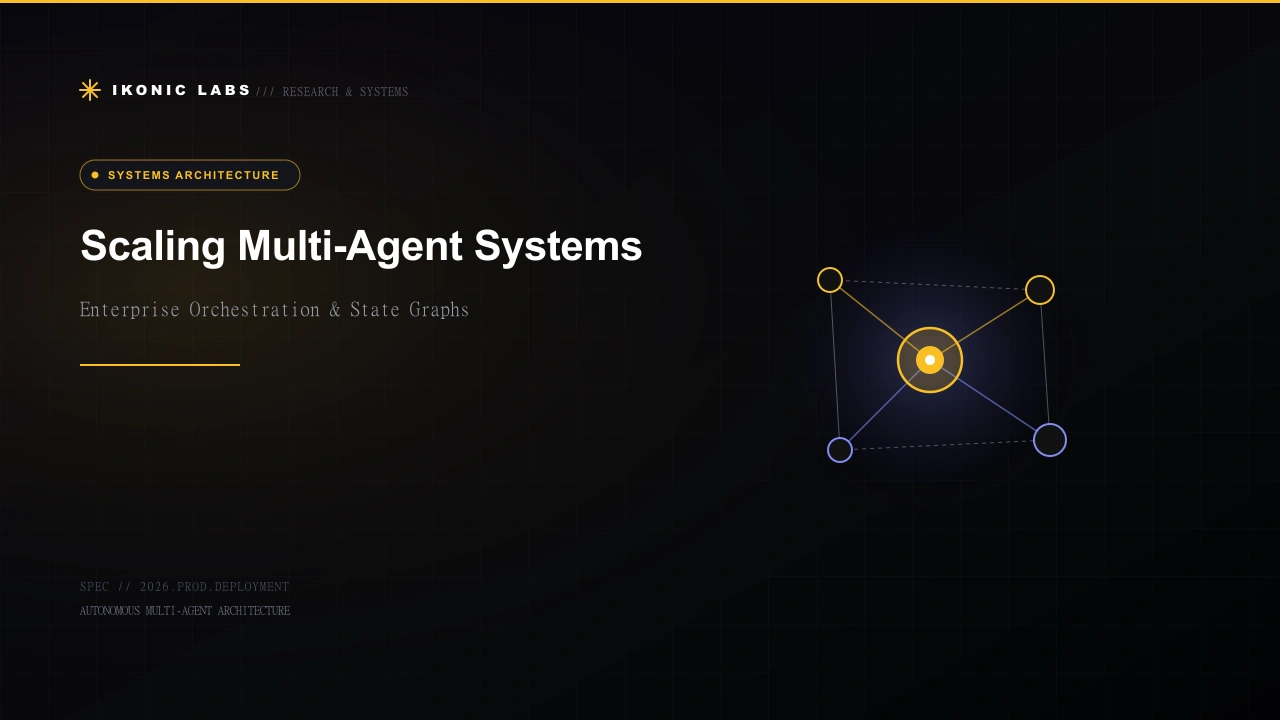
As enterprises push generative AI beyond interactive chat interfaces into operational workflows, single-prompt architectures encounter severe structural limitations. When a single large language model is tasked with multi-step reasoning, external tool execution, dynamic context retrieval, and data transformation, reasoning fidelity degrades, hallucination rates climb, and latency variance spikes. The industry standard for enterprise scalability is the deployment of a multi-agent system—decoupling complex enterprise objectives into specialized cognitive services coordinated by supervisory state machines.
At IKONIC LABS, we have architected multi-agent swarms for high-throughput fintech auditing, automated logistics dispatching, and omnichannel sales qualification (Lead IQ Case Study). This comprehensive guide explores the core architectural patterns, memory tiering fabrics, loop prevention governors, and enterprise ROI models required to scale multi-agent systems reliably in 2026.
⚡ IKONIC LABS • AI Systems Engineering
Ready to Deploy Custom AI Agents for Your Enterprise?
From 48hr scoping to production SaaS and multi-agent workflows — built by engineers who ship.
2. Core Architectural Patterns for Multi-Agent Systems
1. Hierarchical Supervisor-Worker Topology
A designated Supervisor Agent functions as the cognitive router. It evaluates incoming tasks, constructs a dynamic Directed Acyclic Graph (DAG), delegates sub-tasks to specialized worker agents (e.g., Data Extraction, Policy Verification, SQL Querying, API Mutation), synthesizes the outputs, and validates them against safety schemas before returning final results. Learn more in our Multi-Agent Swarm Architectures Blueprint.
2. Sequential Verification Pipeline Graph
A linear or branching chain where each agent's output is programmatically validated by a specialized Critic or Guardrail Agent before proceeding to downstream nodes. This architecture is standard in regulated fintech and healthcare environments where compliance verification is mandatory.
3. Asynchronous Message-Driven Mesh
Agents communicate asynchronously via high-throughput message brokers (Redis Streams, RabbitMQ, or NATS). This decoupled approach allows individual agent nodes to scale horizontally across distributed Kubernetes pods without blocking upstream orchestration threads.
3. Shared Memory Fabric: 3-Tier State Management
Scaling multi-agent systems requires decoupling short-term working context from durable relational records and long-term semantic knowledge:
| Memory Layer | Technology Substrate | Latency SLA | Functional Purpose |
|---|---|---|---|
| Hot Ephemeral State | Redis Cluster / In-Memory StateGraph | < 5ms | Active task thread execution, token buffers, and sub-agent message passing. |
| Warm Relational Checkpoints | PostgreSQL (PostgresSaver) | < 25ms | Durable binary state serialization after every node transition, crash recovery, and time-travel replay. |
| Cold Semantic Long-Term Memory | Pinecone / Supabase pgvector | < 60ms | Persistent vector knowledge, historical client interactions, and domain documentation (RAG Guide). |
4. Production Multi-Agent Implementation in Python & LangGraph
Below is a production-grade implementation of a Supervisor-Worker multi-agent system with state checkpointers:
from typing import TypedDict, Annotated, List, Literal
from langchain_core.messages import BaseMessage, HumanMessage, AIMessage
from langgraph.graph import StateGraph, END
from langgraph.checkpoint.postgres import PostgresSaver

# 1. Define strongly typed multi-agent shared state
class MultiAgentState(TypedDict):
    messages: list[BaseMessage]
    active_worker: str
    intermediate_data: dict
    audit_passed: bool
    iterations: int

# 2. Supervisor Node: Cognitive Routing & Delegation
def supervisor_router_node(state: MultiAgentState) -> dict:
    messages = state["messages"]
    last_msg = messages[-1].content
    iterations = state.get("iterations", 0) + 1

    # Circuit breaker: Hard limit on internal reasoning iterations
    if iterations > 8:
        return {"active_worker": "FINISH", "iterations": iterations}

    if not state.get("intermediate_data"):
        return {"active_worker": "researcher", "iterations": iterations}
    elif not state.get("audit_passed"):
        return {"active_worker": "compliance_critic", "iterations": iterations}
    else:
        return {"active_worker": "FINISH", "iterations": iterations}

# 3. Specialized Worker Nodes
def researcher_agent(state: MultiAgentState) -> dict:
    data = {"company_valuation": 45000000, "market_multiple": 8.5, "revenue_growth": 0.42}
    return {
        "intermediate_data": data,
        "messages": [AIMessage(content="Extracted financial metrics from SEC filings.")]
    }

def compliance_critic_agent(state: MultiAgentState) -> dict:
    data = state["intermediate_data"]
    # Deterministic validation check
    is_valid = data.get("revenue_growth", 0) > 0.10
    return {
        "audit_passed": is_valid,
        "messages": [AIMessage(content="Compliance audit verified: Growth metrics satisfy investment policy criteria.")]
    }

# 4. Assemble Graph Topology
builder = StateGraph(MultiAgentState)
builder.add_node("supervisor", supervisor_router_node)
builder.add_node("researcher", researcher_agent)
builder.add_node("compliance_critic", compliance_critic_agent)

builder.add_conditional_edges(
    "supervisor",
    lambda state: state["active_worker"],
    {
        "researcher": "researcher",
        "compliance_critic": "compliance_critic",
        "FINISH": END
    }
)
builder.add_edge("researcher", "supervisor")
builder.add_edge("compliance_critic", "supervisor")

app = builder.compile()
5. Fault Tolerance: Token Governors & Circuit Breakers
In distributed multi-agent systems, unmonitored agent interactions can enter recursive feedback loops that exhaust token budgets and degrade API response times. Enterprise deployments must enforce three programmatic governors:
- Recursion Limits: Hard-coded iteration ceilings (e.g.,
recursion_limit=15) that automatically abort runaway execution and route to a dead-letter queue. - Per-Task Token Caps: Dynamic token governors that terminate exploratory reasoning when cumulative inference spend reaches pre-allocated financial thresholds.
- Exponential Backoff Circuit Breakers: Automatic cooldowns when external APIs or tool endpoints return transient 500 errors.
6. Scale Multi-Agent Systems with IKONIC LABS
Building reliable, enterprise-grade multi-agent architectures requires specialized systems engineering. At IKONIC LABS, we architect, test, and deploy production-grade multi-agent swarms with guaranteed SLAs, private VPC deployments, and complete code ownership. Compare frameworks in our LangGraph vs CrewAI Analysis.
Ready to deploy scalable multi-agent systems for your organization? Book a technical consultation with our lead AI systems architects today.